FinFest 2026 Panel: Crypto, AI and the road ahead
Six questions put to a panel on crypto’s place in modern portfolios, answered from Foundry Labs research, evidence to Parliament and public sources: the cycle, digital gold, drawdowns, who is buying, stablecoins and tokenisation, and AI agents.
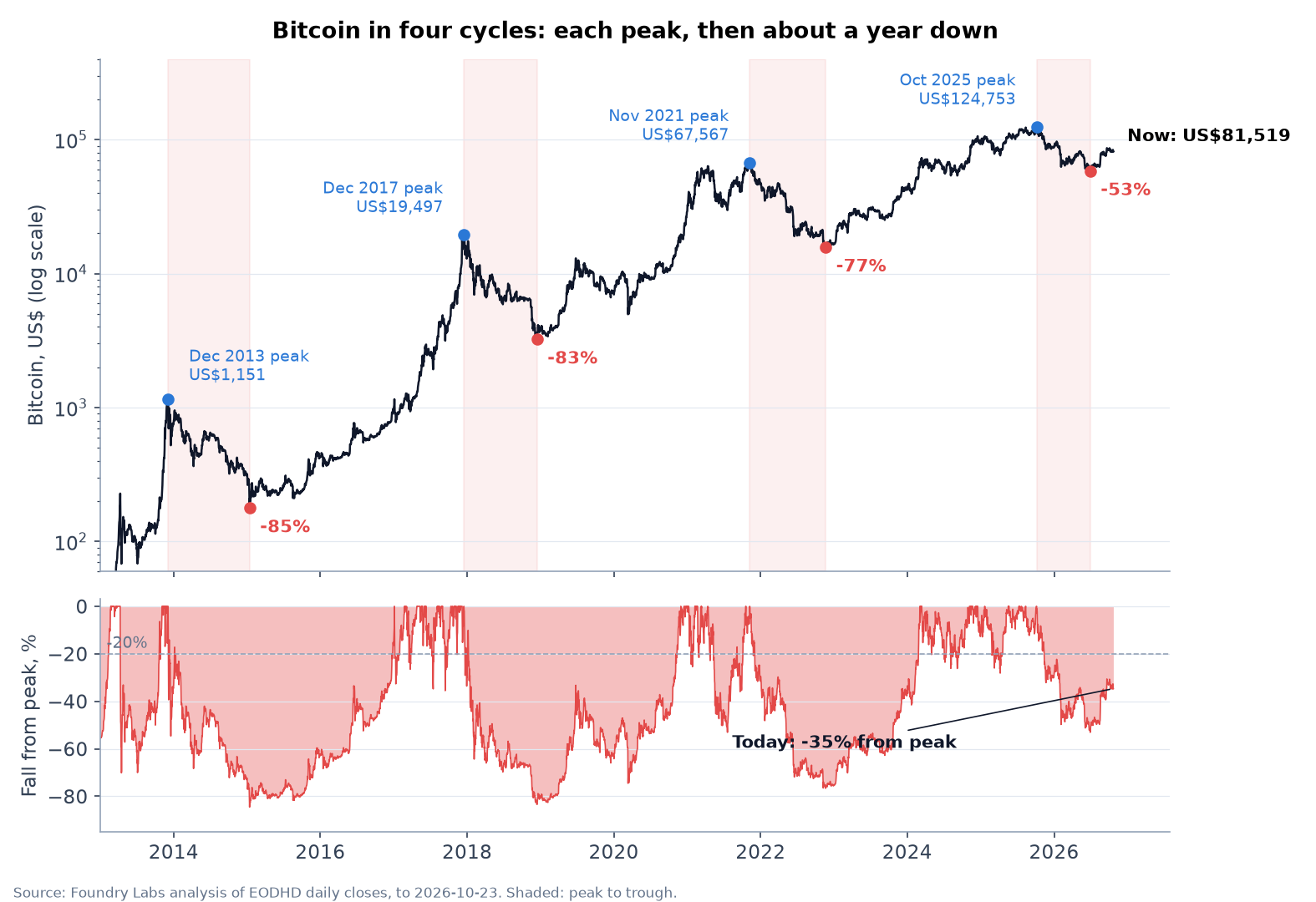
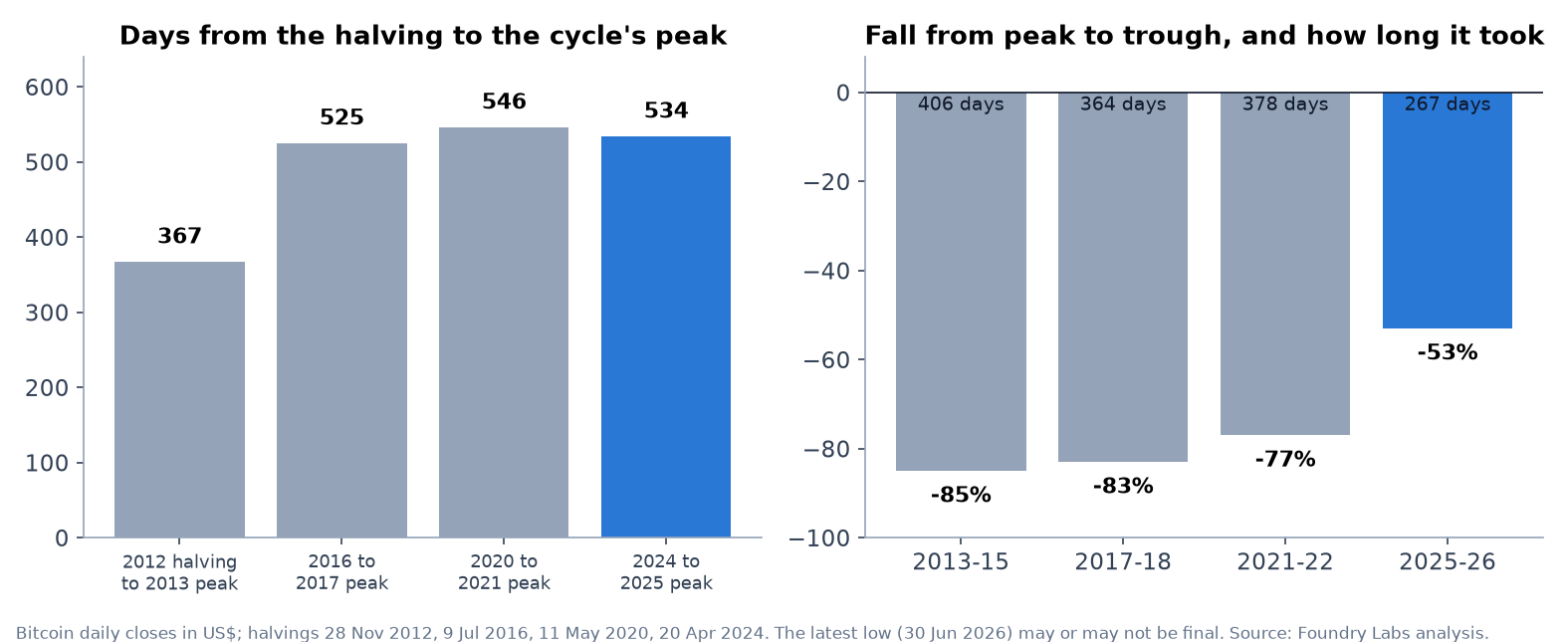
1. The cycle. The four-year pattern has held on timing, but this fall was shallower and shorter (−53% in 267 days, against −77% to −85% before), and nobody can say whether June was the bottom.
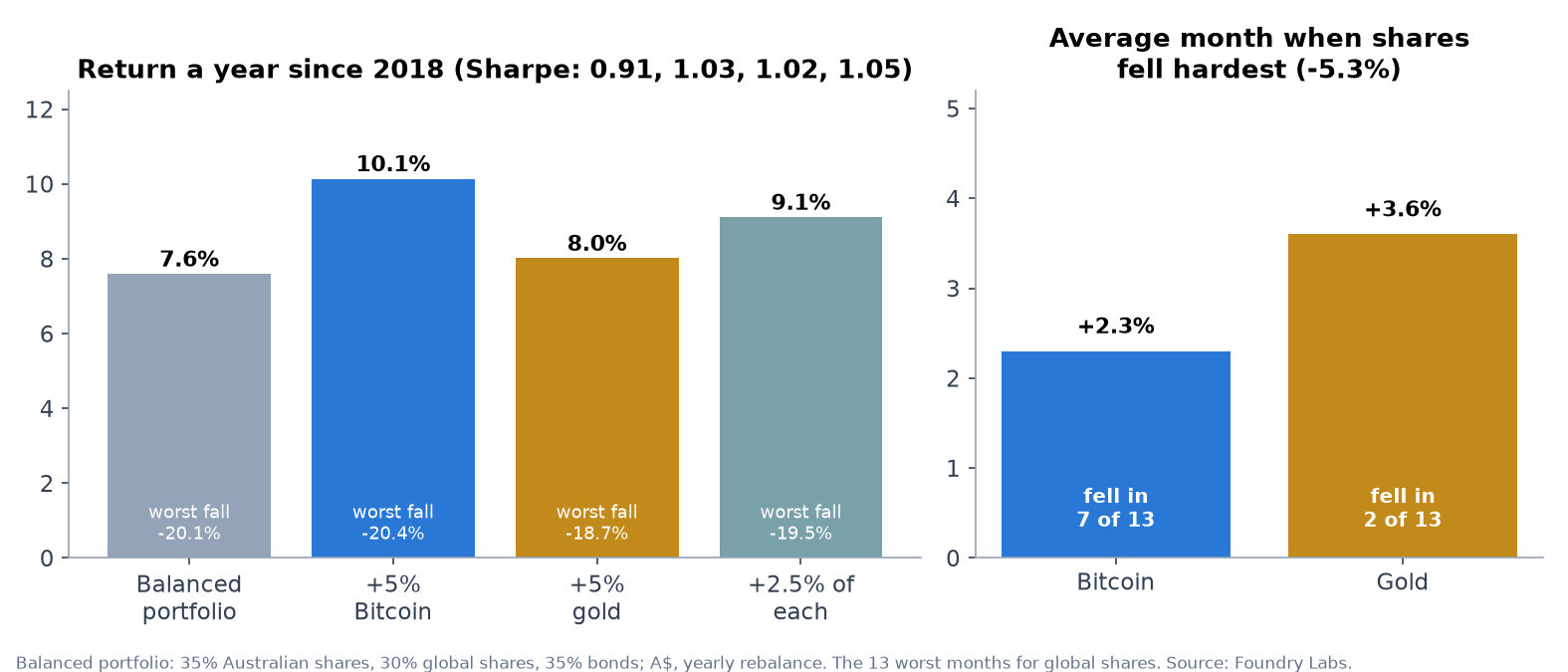
2. Digital gold. Growth, and a volatile one. In the 13 worst months for shares, Bitcoin fell in 7 and gold rose in 11. Size matters more than the label: a 5% slice is about 14% of a portfolio’s risk.
3. Drawdowns. Plan for 70 to 80% on the Bitcoin itself. It fell 85%, 83% and 77% in the last three cycles, and beyond Bitcoin the data are worse.
4. Who is buying. Mostly cautiously and small, through advisers and arbitrage desks. Filings show only about a fifth of the money in the US spot ETFs, and surveys put institutional allocations at 1 to 2%.
5. Stablecoins and tokenisation. The part of crypto that regulators and incumbents are adopting. Australia leads on wholesale tokenisation and is behind on stablecoin rules.
6. AI agents. An agent that acts needs a way to prove who it is, to pay in tiny amounts instantly, and a record of what happened. Blockchains and stablecoins do those jobs, and the ACCC told Parliament agentic commerce is a priority.
Where we write from. These are Mark Monfort’s answers for the panel, built from Foundry Labs research. Mark is Co-Founder of NotCentralised, which ran a use case in the Reserve Bank’s Project Acacia (questions 5 and 6), and Co-Chair of the AI Working Group of the Digital Economy Council of Australia, which is cited in questions 5 and 6.
The panel
From Speculation to Strategy: Crypto’s Place in Modern Portfolios
The moderator proposed the six questions below after meeting both panellists. Roles are from public sources.
| Panellist | Role |
|---|---|
| Mark Monfort | Managing Director, Foundry Labs. Co-Chair of the AI Working Group, Digital Economy Council of Australia. Co-Founder and AI Implementation Lead, NotCentralised. |
| John O’Loghlen | Regional Managing Director APAC and Country Director, Coinbase Australia. |
How to read the source tags. Each line says where it comes from.
PAPER 1 / 2 / 3 Foundry Labs papers of 3 October 2026: Bitcoin in a Balanced Portfolio, Crypto Is Not One Bet and How You Hold It Matters. PAPER 1 / 2 / 3 · UPDATED the line has at least one number that the published paper does not print, from the same research on later data, so it can differ from the paper. OUR RESEARCH Foundry Labs analysis, including work not yet published. PRIMARY read at the source: a government page, Hansard or the report itself. OUR EXPERIENCE first-hand account of Foundry Labs and NotCentralised, for example in the Reserve Bank’s Project Acacia. PUBLIC SOURCES news, industry reports and adviser sites: reasonable, not primary. UNCONFIRMED sources conflict, are older, or could not be found.
01 · Question 1
“Where are we in the market cycle right now, and are the old four-year cycle rules still relevant?”
Follow-up. what is different this time, and what would change your view?
Evidence
- The calendar pattern. Peaks came 367, 525, 546 and 534 days after the halving (the latest was 6 Oct 2025, 534 days after April 2024). Then roughly a year of decline each time. OUR RESEARCH
- This cycle's fall was shallower and shorter: -53% in 267 days to US$58.6k on 30 June 2026, against -77% to -85% in about a year for the earlier cycles. Since then it has recovered 39%. OUR RESEARCH
- Time to recover an old peak after the trough: 469 to 721 days in the three earlier cycles. Today it is 35% below the peak. OUR RESEARCH
- The cycle believers: some analysts (for example Benjamin Cowen) pointed to an October 2026 bottom and a deeper fall (about 75%); that deeper fall has not happened so far. PUBLIC SOURCES
- The sceptics: Grayscale argued ETFs and corporate holders make the cycle less reliable and expected new highs in 2026, which has not happened either. A middle view is that the cycle is compressing, not dead. PUBLIC SOURCES
- What drives the moves has changed. In 2025-26 the biggest days were tariff headlines, spot ETF flows turning, a large corporate holder selling and leveraged liquidations, such as the 10 Oct 2025 crash (about US$19bn of positions wiped out). Shares and other markets explain only about 5% of weekly moves overall. OUR RESEARCH / PUBLIC SOURCES for the individual events
Follow-up: what is different this time, and what would change my view?
- Who owns it has changed. Filers of US 13F reports held about 264,000 BTC at the end of June 2026, 22.4% of US spot ETF assets (advisers the largest group), and the US spot ETFs hold roughly US$100bn. Earlier cycles had no regulated spot product. PRIMARY (CoinShares 13F report) PUBLIC SOURCES (ETF assets)
- The fall was shallower and shorter: -53% in 267 days, against -77% to -85% in about a year each. That could mean the cycle is compressing, or that this fall is not finished. OUR RESEARCH
- What moves the price: inflation-release days produce moves about 26% bigger than normal; 2025-26's biggest days were tariff headlines, ETF flows turning and leveraged liquidations. OUR RESEARCH PUBLIC SOURCES
- What would change my view (a watch-list, not a forecast): (1) a daily close below US$58.6k, the 30 June low, would say the bottom is not in and the old pattern's depth may still be coming; (2) a return to the October 2025 high of US$124.8k would say the four-year rhythm has been broken upward; (3) sustained spot ETF outflows after a run of inflows (October has swung from outflows to inflows); (4) the Federal Reserve's 28 October decision and the rate path, since a hike would test the macro link seen since 2020. Our view
02 · Question 2
“Has Bitcoin earned its reputation as digital gold, or should investors think of it more as a high-growth risk asset? And what does that mean for how much belongs in a portfolio?”
Follow-up. is 5% Bitcoin becoming the new 1%, or is that too aggressive?
Digital gold? Bitcoin against gold
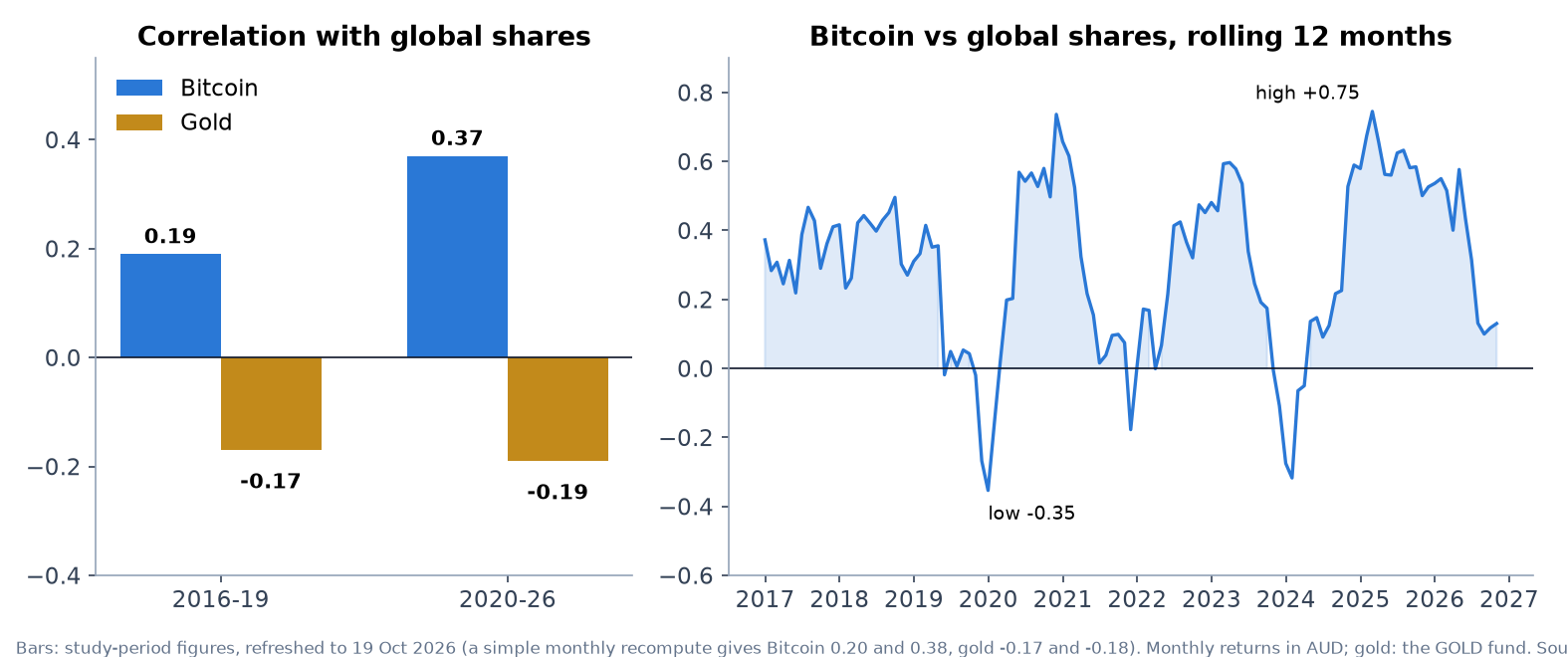
- Correlation with global shares: Bitcoin 0.19 (2016-19), 0.37 (2020-26); gold -0.17 and -0.19. PAPER 1 · UPDATED
- Worst 13 months for shares (average -5.3%): Bitcoin averaged +2.3% but fell in 7; gold averaged +3.6% and fell in only 2. PAPER 1
- Added to a balanced portfolio (from 2018): +5% Bitcoin 10.1% a year (worst fall -20.4%); +5% gold 8.0% (worst fall -18.7%); 2.5% of each 9.1% with the highest Sharpe ratio (1.05; 1.30 from 2016). PAPER 1 · UPDATED
- Alone: from 2016 Bitcoin returned 63% a year with an 82% worst fall; gold 13% with a 27% worst fall. OUR RESEARCH
How it behaves: growth, with a link to shares that comes and goes
- Correlation with global shares: 0.19 in 2016-19, 0.37 in 2020-26; with bonds 0.15 then 0.07. The 12-month rolling figure has ranged from roughly -0.3 to +0.7, so it is unstable. PAPER 1 · UPDATED OUR RESEARCH
- Not a crash hedge: in the 13 worst months for global shares, Bitcoin averaged +2.3% but fell in 7; gold averaged +3.6% and rose in 11. Gold's correlation with shares was about -0.17 to -0.19. PAPER 1
- The link with shares comes and goes: near zero before 2020, then 34% of Bitcoin's daily moves explained by the Nasdaq in 2022 and 17-22% in 2025-26. Across 2016-2026 only about 5.5% of weekly moves are explained by shares, gold, bonds, the dollar and volatility together, so most of its movement is its own. OUR RESEARCH
- Bitcoin and gold together: 2.5% of each gave the best Sharpe ratio in both windows (1.05 from 2018, 1.30 from 2016). PAPER 1
- What does move it: inflation-release days were about 26% bigger moves than normal days (stronger during the 2020-22 inflation scare, faded since); government and official news was the biggest single cause of its 24 biggest days (7), then crypto-specific events (7). OUR RESEARCH
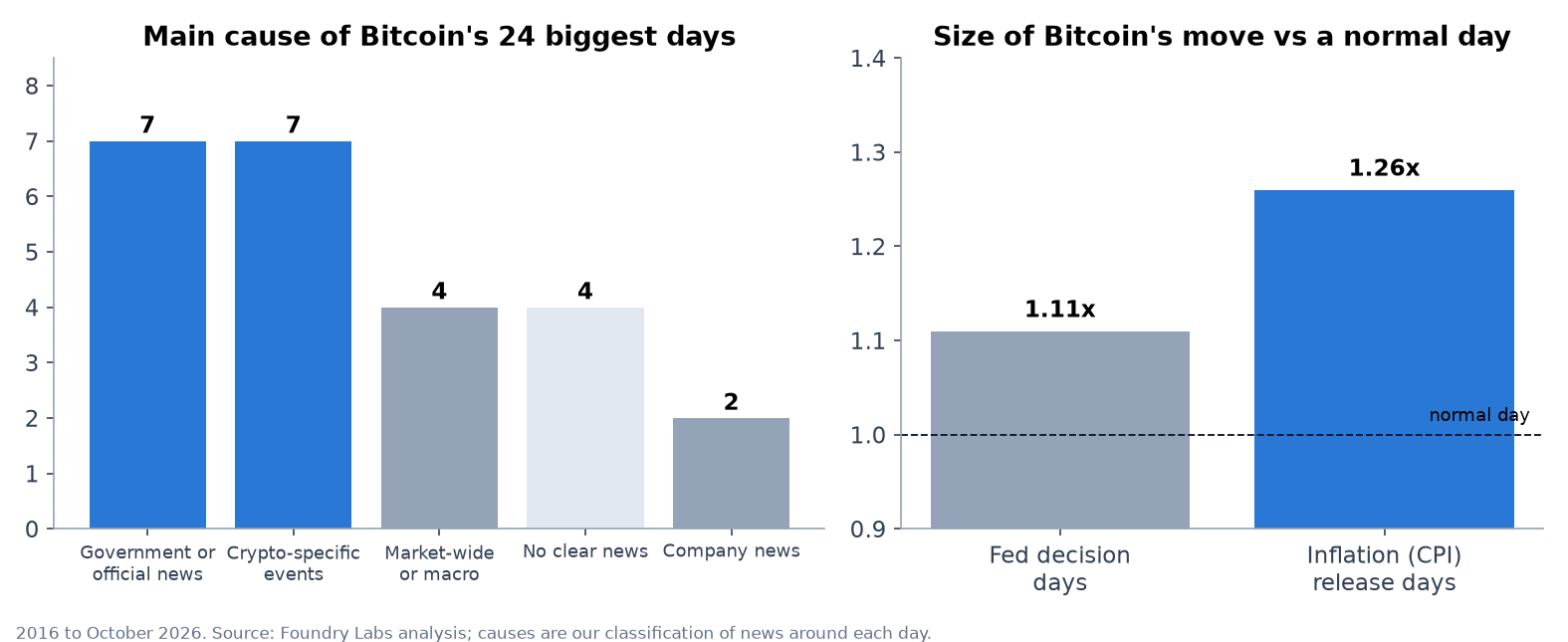
- Government or official (7): China's crackdown on token sales and exchanges on 14 Sep 2017 (-18.7%); South Korea's reported ban on 16 Jan 2018 (-16.9%); China's President Xi backing blockchain on 25 Oct 2019 (+15.6%); the incoming US Treasury Secretary's criticism on 21 Jan 2021 (-13.3%).
- Crypto-specific (7): the SegWit upgrade lock-in on 20 Jul 2017 (+23.9%); the Bitcoin Cash 'hash war' on 19 Nov 2018 (-13.4%); the Celsius lender freezing withdrawals on 13 Jun 2022 (-16.0%); the FTX collapse on 9 Nov 2022 (-14.3%).
- Market-wide or macro (4): the global share sell-off on 5 Feb 2018 (-16.0%); the COVID crash on 12 Mar 2020 (-37.2%) and the rebound on 19 Mar 2020 (+18.2%).
- Company news (2): Tesla buying US$1.5bn of Bitcoin on 8 Feb 2021 (+18.7%) and then stopping Bitcoin payments on 12 May 2021 (-13.3%).
- No clear news (4): 12 Apr 2018 (+13.2%) and 2 Apr 2019 (+17.4%), sudden jumps with no confirmed cause.
What that means for how much belongs in a portfolio, and is 5% the new 1%?
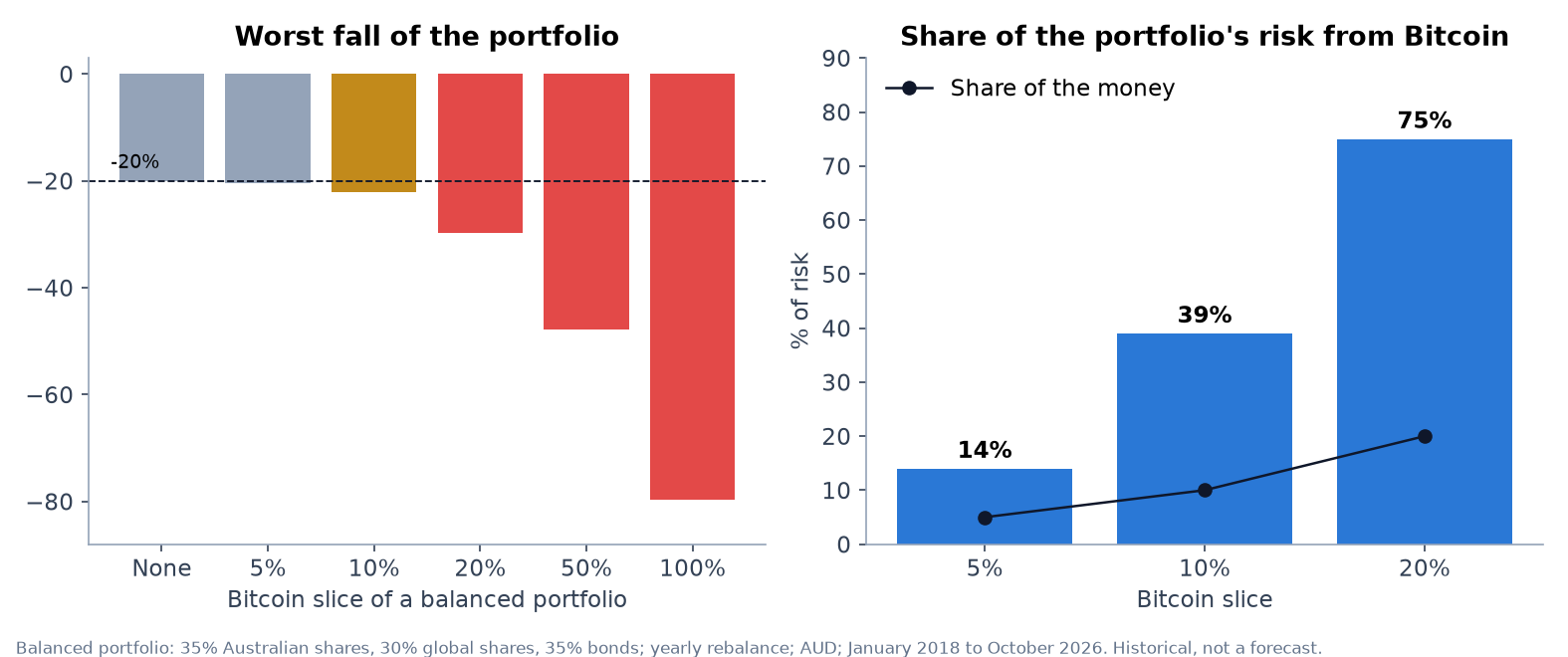
- Share of the portfolio's risk (from 2018): a 1% slice is about 0.9% of the risk; 2% about 2.8%; 5% about 14%; 10% about 39%; 20% about 75%. OUR RESEARCH
- Return and Sharpe ratio (from 2018): no Bitcoin 7.6% a year (Sharpe 0.91); 2% slice 8.5% (0.99), an extra 1.0 points; 5% slice 10.1% (1.04), an extra 2.5 points. From 2016 the 2% slice added 3.3 points and the 5% slice 7.4. PAPER 1 · UPDATED
- Worst fall: about -20% with none, -20% with 2% or 5%, -22% with 10%, -29% with 20%. PAPER 1
- What institutions do: in the Bitwise survey of 15 institutions most allocations were 1 to 2% (range 0.5% to 13%); a promotional source with a small sample. PRIMARY
- Answer by start date: the 5% slice's help shrinks a lot for later starts (the extra return was about 13 points a year for a 2016 start and 3 for a 2021 start, for a 10% slice). OUR RESEARCH
"Risk" here means how much the portfolio's value bounces around, its ups and downs. "Share of risk" is how much of that bouncing each holding is responsible for. Money and risk are different things, because Bitcoin bounces far more than shares and bonds: about 63% a year since 2018, against roughly 8 to 9% a year for a balanced mix of shares and bonds. So 20 cents of every dollar in Bitcoin behaves like a much bigger position.
A rough check you can do in your head. The Bitcoin slice adds about 0.20 × 63 = 12.6 points of bounce. The other 80% of the portfolio adds about 0.80 × 8.5 = 6.8 points. Bounces combine as squares (like sides of a right-angled triangle), so Bitcoin's part is about 159 against 46 for everything else. That makes Bitcoin 159 out of 205, about 78%, close to the 75% measured (the measured figure also allows for how the assets move together). Try 5%: 0.05 × 63 = 3.2 against 0.95 × 8.5 = 8.1, which gives about 10 against 65, or 13% of the risk, close to the 14% measured.
What it means. At 20% the portfolio is no longer "a balanced portfolio with a little Bitcoin": roughly three-quarters of its ups and downs come from Bitcoin, so how the whole portfolio does is mostly a Bitcoin decision. At 1 to 2% Bitcoin is a satellite whose bounce barely registers. It does not say you would lose 75% of your money; it says where the swings come from. OUR RESEARCH
03 · Question 3
“If you are investing in Bitcoin for the next 10 years, what sort of drawdown should you realistically be prepared for, and how does that influence who should own it?”
Follow-up. does the answer change beyond Bitcoin, into Ethereum and other crypto assets?
Evidence
| Cycle | Peak | Trough | Fall | Peak to trough | Trough to old peak |
|---|---|---|---|---|---|
| 2013-15 | Dec 2013, US$1,151 | Jan 2015, US$178 | -85% | 406 days | 721 days |
| 2017-18 | Dec 2017, US$19,497 | Dec 2018, US$3,237 | -83% | 364 days | 716 days |
| 2021-22 | Nov 2021, US$67,567 | Nov 2022, US$15,787 | -77% | 378 days | 469 days |
| 2025-26 | Oct 2025, US$124,753 | Jun 2026, US$58,559 | -53% | 267 days | not yet |
OUR RESEARCH Daily closes in US dollars. In Australian dollars the 2025-26 fall was -55%.
- What it does to a portfolio: a 5% slice cost about 4 points of the portfolio at an 80% fall; 20% of the portfolio would be down about 16 points from the Bitcoin alone. Portfolio worst falls: -20% (none), -20% (5%), -22% (10%), -29% (20%), -48% (50%), -80% (100%). PAPER 1 · UPDATED OUR RESEARCH
- Time under water: a portfolio with a 50% Bitcoin slice spent about two years below its old high. Bitcoin alone spent about 35 months. OUR RESEARCH
- Behaviour is the real risk. Selling after a 50% fall and buying back a year later cost 1.4 to 1.7 points a year. Never rebalancing from 2016 let Bitcoin grow to 88% of the portfolio, and the worst fall was -62%. The average dollar in Australian crypto funds earned -9.7% a year while the funds made 11.3%. PAPER 3 · UPDATED
- Who it suits (as a framework, not advice): someone who can hold through an 80% fall and a multi-year recovery without selling, with a size where that fall is bearable, and a plan for rebalancing. If they would sell at -50%, the data say the cost of doing so is high. OUR RESEARCH
Follow-up: does the answer change beyond Bitcoin, into Ethereum and other crypto?
- Ethereum from 2021: 17.2% a year with a worst fall of -76.7% and a Sharpe ratio of 0.49, against Bitcoin's 19.3%, -73.8% and 0.57. As a 5% slice in a balanced portfolio: Ether 9.4% a year, worst fall -19.5%, Sharpe 0.94; Bitcoin 9.0%, -17.6%, 1.03. A 70/30 Bitcoin and Ether mix: 9.2% a year, worst fall -18.2%, Sharpe 1.01. PAPER 2 · UPDATED
- Other large coins (from 2021) fell 66.3% to 94.9% at their worst, even where returns were large (Solana 93.3% a year but a 95.7% fall). Dogecoin as a 5% slice cut the portfolio's Sharpe ratio to 0.45. PAPER 2 · UPDATED
And the wider market: Bitcoin against baskets of coins
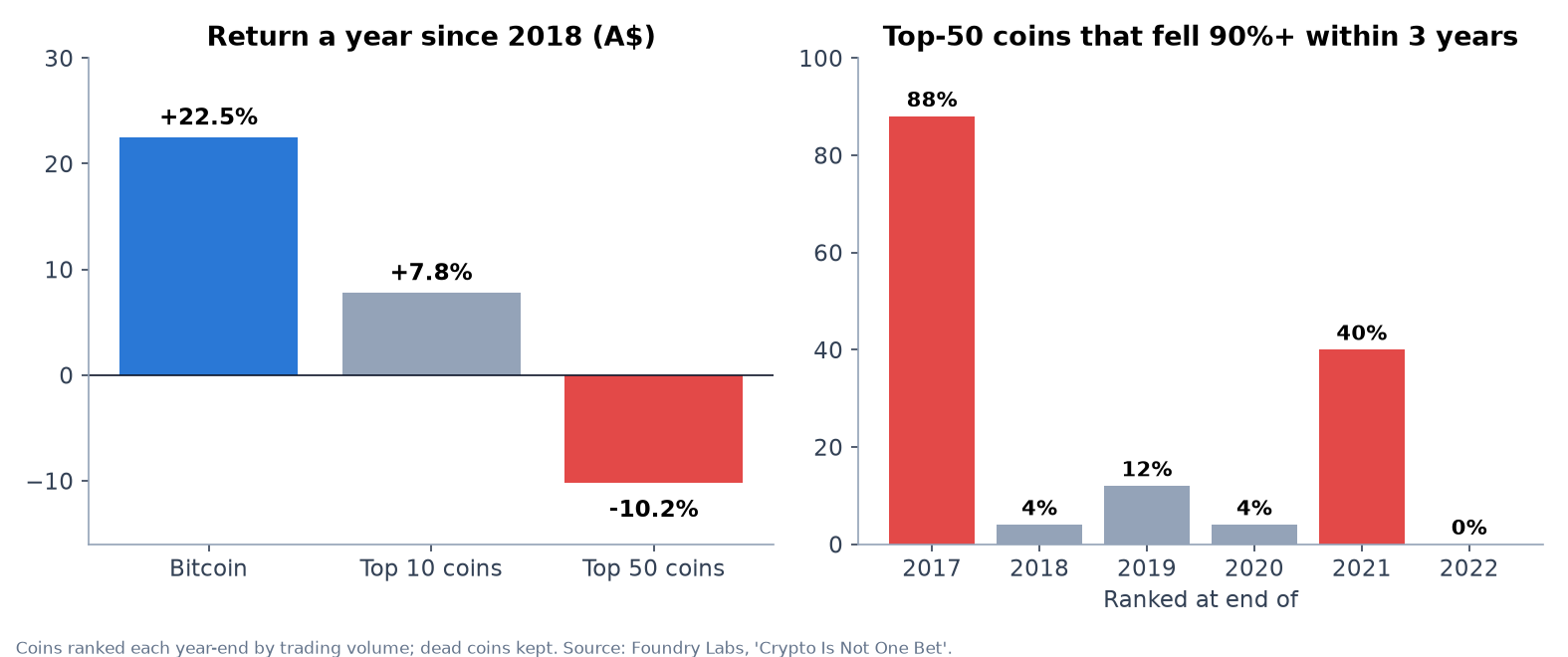
- Basket vs Bitcoin: since 2018, Bitcoin +22.5% a year; top 10 +7.8%; top 50 -10.2% (dead coins kept in). PAPER 2 · UPDATED
- Survival: 44 of the 50 largest coins at end-2017 lost 90% or more within three years; 40% of the end-2021 list did. Bitcoin was number one by volume every year. PAPER 2
- Other big coins, from 2021: Solana made 93% a year but fell 96%; every one of seven large coins fell two-thirds or more. As a 5% slice only Bitcoin improved the portfolio's Sharpe ratio (1.03 against 0.97); Ether returned slightly more but with a lower Sharpe and deeper fall; Dogecoin cut it to 0.45. PAPER 2 · UPDATED
- Picking winners is hard: there was always a big winner among the top five, but not always the same coin, and some lost 79 to 91% in three years. The coins we can name today are survivors. OUR RESEARCH
- Famous factors: momentum did not work; calmer coins and coins without recent spikes ranked better; one portfolio version (drop the spikiest fifth) beat the basket by 7.0% a year but still lost 3.5% a year. PAPER 2 · UPDATED
- Stablecoins are payment tools, not investments: they were excluded from the tests. (A statement of method, not a finding.)
04 · Question 4
“Who is actually buying Bitcoin today: financial advisers, hedge funds, pension funds or retail investors? Are we seeing genuine long-term adoption or just another way to trade Bitcoin?”
Follow-up. here in Australia, what needs to change before crypto becomes a more mainstream allocation, particularly within SMSFs?
Which institutions, and how much
- Typical size: Bitwise's report (published 23 Sept 2026; read at the source) interviewed senior professionals at 15 of the world's largest institutions (endowments, foundations, public pension funds, multi-family offices, consultants, sovereign wealth funds and public companies). Allocations ranged from 0.5% to 13% of investable assets, with most between 1% and 2%. Family offices had the highest allocations and sovereign wealth funds the lowest. No institution reduced its allocation during the roughly 50% fall between Q4 2025 and Q2 2026, and several bought more. Every holder owns Bitcoin first; Ether and Solana are smaller, shorter-horizon positions. PRIMARY Caveat: Bitwise sells crypto products, so the framing is promotional, and 15 institutions interviewed is not a representative survey.
- BlackRock has been reported as recommending a 1-2% allocation. PUBLIC SOURCES
- Vendor estimates of 2-8% for clients of one advisory firm are weaker evidence. PUBLIC SOURCES
- Australia: AMP put about A$27m (about 0.05% of its A$57bn) into Bitcoin futures in 2024. Hostplus was reported in March 2026 to be designing crypto access within its self-directed ChoicePlus option (about 1% of its assets), pending regulatory approval. AustralianSuper said in 2024 it had no plans to invest directly; other large funds were reported as sceptical. UNCONFIRMED (2024 items; no Hostplus launch found as of 23 Oct 2026)
- Not found: a primary source naming pension funds' actual positions.
Who is buying the spot ETFs
- Size: about US$58bn of cumulative net inflows (US$57.96bn at 21 Oct on SoSoValue) and about US$100-104bn of assets in mid-October 2026 (trackers differ by a billion or two; no later assets figure found). Flows have swung: roughly US$3bn in during 17-25 Sept, about US$0.6bn out in the first half of October, then about US$1.1bn back in over 19-21 Oct, so October to date is about +US$0.46bn. Spot Ether ETFs were about US$1bn out to 16 Oct (a later figure was not found). PUBLIC SOURCES
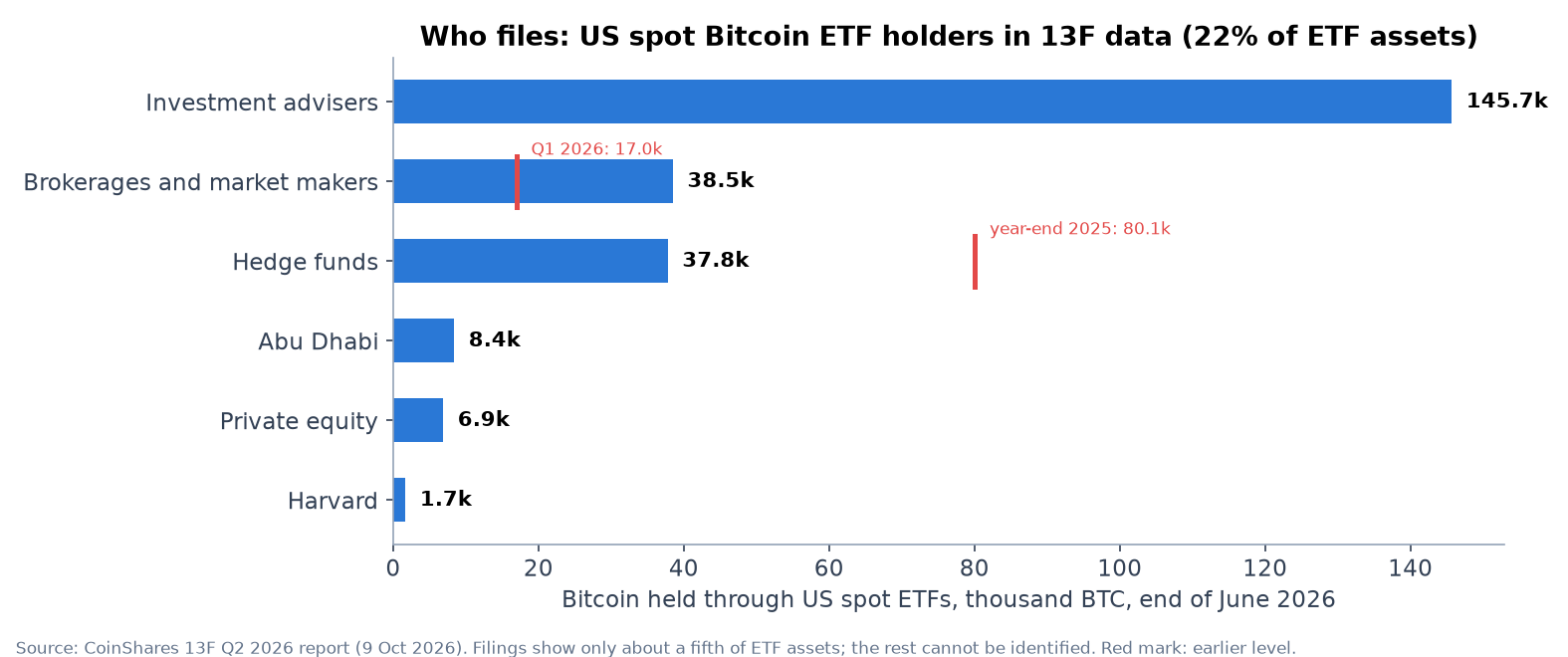
- Who files (13F, Q2 2026; CoinShares report of 9 Oct 2026, read at the source): filers held 264,000 BTC, up 1.3% on Q1, rising from 20.8% to 22.4% of US spot ETF assets. Advisers held 145,700 BTC (about 55% of filings; Brevan Howard cut from 13,700 to 4,100). Hedge funds cut by 22% to 37,800 BTC, less than half the year-end level of 80,100 (D. E. Shaw exited; Millennium fell from 14,400 to 7,300). Brokerages rose to 38,500 from 17,000 (Jane Street 16,900; Morgan Stanley 10,400). Governments and endowments broadly unchanged: Abu Dhabi 8,400, Harvard 1,700, Brown 121, Dartmouth 114. Private equity up 5% to 6,900. The report gives no pension-fund figure. Holders outside 13F data cut by 8.3%. PRIMARY
- Pensions: one commentary says they are not significant holders. That is a lead, not a finding. UNCONFIRMED
- The other 78%: holders that do not appear in 13F data (including individuals) cannot be identified from filings. The honest phrasing is "what we can see", not "who is buying".
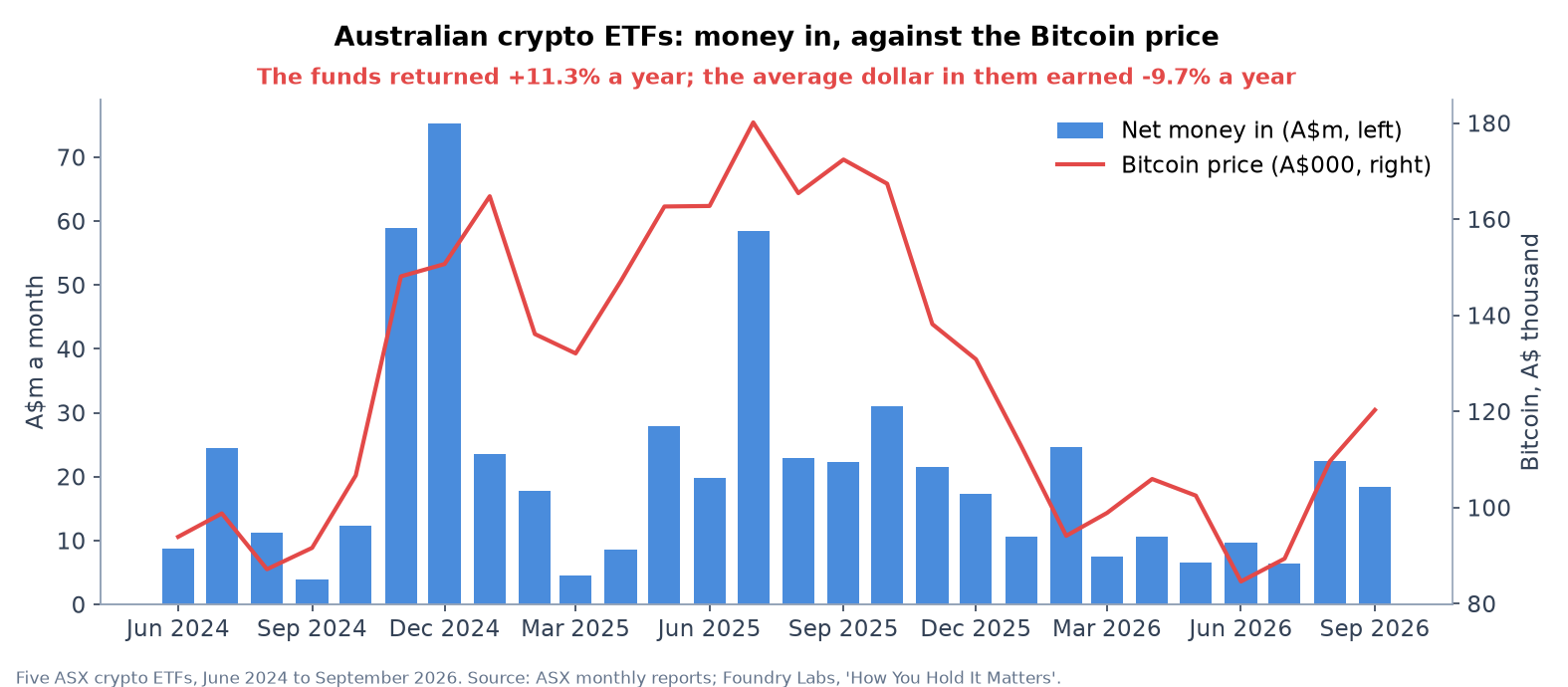
- Australian angle (ours): the five crypto ETFs in our ASX data (BTXX, IBIT, QBTC, QETH, VBTC) held about A$524m in September 2026 (other crypto funds, such as Monochrome's, were not in the ASX reports); monthly flows followed the previous month's price (correlation +0.59); the average dollar earned -9.7% a year while the funds made 11.3%. People bought after price jumps and kept buying as it fell. PAPER 3 · UPDATED
Follow-up: what needs to change before crypto becomes a more mainstream allocation, particularly in SMSFs?
- Products and licensing: spot Bitcoin ETFs already trade on the ASX, and ASIC has indicated Bitcoin and Ether are the crypto-assets likely to meet its criteria for an exchange traded product's underlying asset. From about April 2027 digital asset platforms need an Australian financial services licence, and ASIC's CP 392 (closes 27 November 2026) sets the capital, custody and disclosure rules. PRIMARY (ASIC) PUBLIC SOURCES (dates)
- Custody, valuation and audit: the fund must hold the asset in a wallet in its own name, separate from trustees' personal crypto, with objective 30 June valuation evidence; auditors are rejecting screenshots. A standard routine (and licensed custodians) would make this routine for ordinary trustees. PUBLIC SOURCES
- Super fund access: Hostplus was reported in March 2026 to be designing crypto access in its self-directed option; no launch had been reported by 23 October 2026. UNCONFIRMED
- Tax: the CGT reform from 1 July 2027 replaces the individual 50% discount with indexation and a 30% minimum tax, while complying super funds, including SMSFs, keep their one-third discount. PUBLIC SOURCES (verify on the ATO site)
- Behaviour: in Australian crypto ETFs the average dollar earned -9.7% a year while the funds made 11.3%, because money followed the price. PAPER 3 · UPDATED
The SMSF numbers behind it
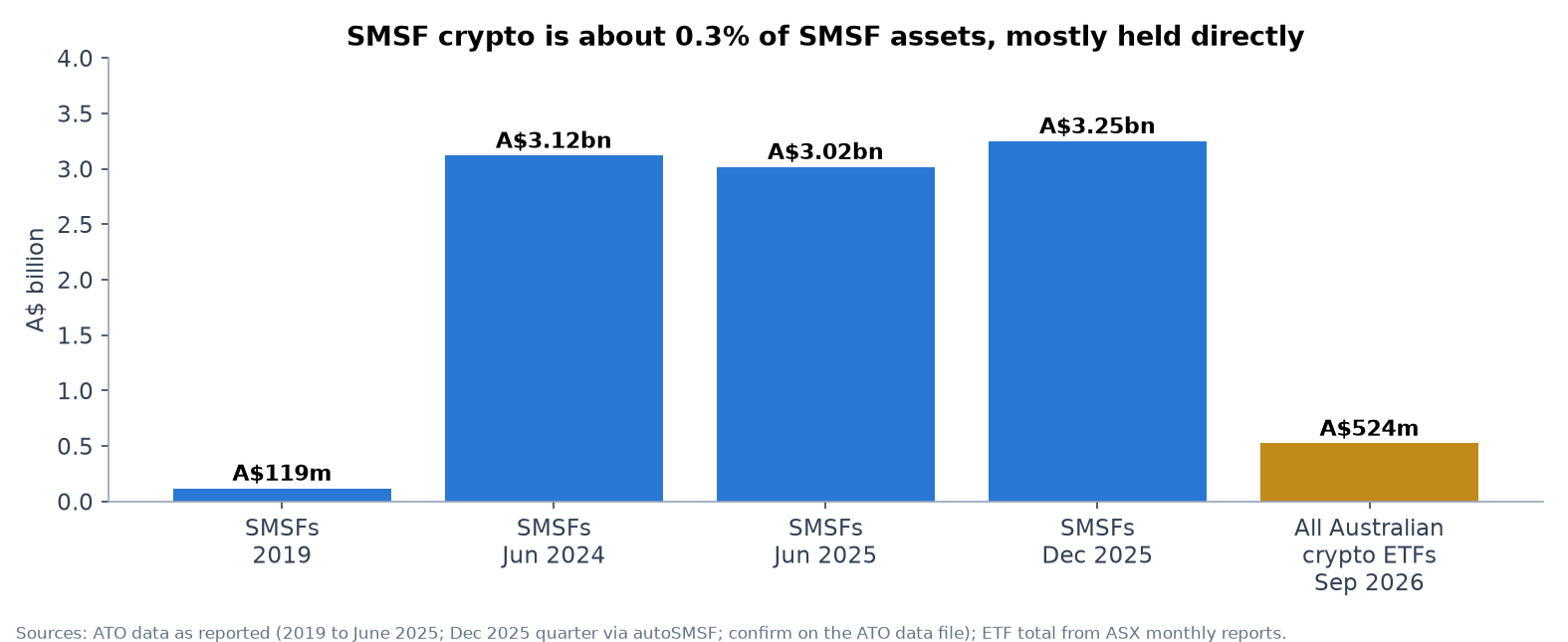
- ATO data: about A$3.02bn at June 2025, down about 4% from about A$3.12bn a year earlier, up from about A$119m in 2019. The December 2025 quarterly report is quoted as A$3.25bn, 0.3% of total assets (autoSMSF, citing the ATO). The ATO's June 2026 quarterly report (highlights dated 8 Sept 2026) lists 680,301 SMSFs and A$1.107 trillion of assets; I did not find a 2026 crypto line. The ATO treats these as estimates because funds have two years to lodge. PUBLIC SOURCES One commentary quotes about A$5.0bn at March and June 2026; no other source supports it. The ATO's SMSF statistics data file is the primary source.
- Tax difference: under the CGT reform (law since June 2026), individuals lose the 50% discount from 1 July 2027 (indexation and a 30% minimum tax replace it), while complying super funds, including SMSFs, keep their one-third discount. That is a factual change in the rules, not a recommendation. PUBLIC SOURCES (verify on the ATO site)
- How it is held: the A$3bn is much bigger than the five Australian crypto ETFs in our data put together (about A$524m across all investors), so most SMSF crypto must be held directly, not through ETFs (other crypto funds may exist outside our data, but are unlikely to change that). Inference from our ETF data
- Tailwinds: regulated ETFs now listed on the ASX (IBIT, VBTC, BTXX, QBTC and others); a new licensing regime; large funds starting to explore access (Hostplus); more advisers and accountants comfortable with the audit. PUBLIC SOURCES
- Headwinds: falls like the 53% decline this cycle; the practical burden of custody, valuation and audit; trustee knowledge. The same behaviour risk shows up in our ETF data (people buy after rises).
- A fair framing: from A$119m to A$3bn in six years is fast growth from nothing, but the last year was flat to slightly down while Bitcoin's price rose and fell. Growth in the share of SMSF assets is likely to depend on products and rules more than on price.
Backup: common SMSF mistakes (trust deed wording, separate wallets, 30 June valuation, lost access)
| Mistake | What the sources say | Source |
|---|---|---|
| Trust deed does not allow it | The deed must permit crypto or use wording broad enough to include it; older deeds may not. Review before buying. | PUBLIC SOURCES |
| Investment strategy not updated | A strategy that only mentions shares, fixed interest and property while the fund holds crypto is non-compliant from the first purchase; it should weigh volatility and liquidity. | PUBLIC SOURCES |
| Mixing fund and personal wallets | The ATO's auditing guidance says the asset must sit in a wallet in the fund's name, separate from any crypto held personally by trustees or members. | PUBLIC SOURCES |
| Weak 30 June valuation evidence | Holdings are reported at market value; auditors want objective evidence such as 30 June closing prices from reputable exchanges and are increasingly rejecting screenshots. | PUBLIC SOURCES |
| Sole purpose test | Every investment must be made to provide retirement or death benefits. Buying for personal use or enjoyment is a risk. | PUBLIC SOURCES |
| Security and scams | Private keys and passwords must be stored securely; trustees should watch for impersonation scams. | PUBLIC SOURCES |
| Using an unlicensed or offshore platform | From about April 2027 digital asset platforms must hold an Australian financial services licence, and ASIC is consulting on custody and capital rules. Trustees should check the platform's licence status; the regime does not remove the risk of loss. | PUBLIC SOURCES |
| Lost access | My searches found nothing on how lost keys or recovery are treated for audit and valuation. Single-person key control and the absence of a succession plan are practical risks. | UNCONFIRMED |
| Related-party and personal-account purchases | Not covered in the sources reviewed. SMSFs generally face limits on acquiring assets from related parties, so buying personal crypto and moving it into the fund is a classic trap. Confirm with an SMSF specialist. | UNCONFIRMED |
05 · Question 5
“Is crypto becoming part of the financial system itself? Are stablecoins and tokenisation the real breakthrough for blockchain, and what could they actually improve about the financial system we use today?”
Follow-up. is Australia keeping pace, or at risk of falling behind?
What stablecoins and tokenisation could improve
- Settlement: Project Acacia's final report (18 May 2026) found shorter settlement cycles, 24/7 settlement, better collateral mobility and automation, and atomic delivery-versus-payment, which makes partial settlement technically infeasible. It does not put a dollar figure on the savings. PRIMARY (Acacia report) A figure of about A$24bn a year from the Digital Finance CRC has been reported but is not in the report. UNCONFIRMED
- A working example: our use case in Acacia was a securitisation: a tokenised security backed by loans, settled with a payment token backed by wholesale digital central bank money, so the security and the money moved together on one network (Redbelly). PRIMARY (RBA report) OUR EXPERIENCE
- Payments: Visa said stablecoin settlement ran at about US$7bn annualised in March 2026 across more than 160 card programs (a September report says over US$20bn; the figures differ, so quote each with its date). Stripe announced stablecoin accounts through Bridge and Privy and stablecoin payments in 32 more markets at its April 2026 conference. Mastercard agreed to buy stablecoin firm BVNK for up to US$1.8bn. PRIMARY (Visa, Stripe) PUBLIC SOURCES (Mastercard, the later Visa figure)
- Cross-border payments: the Financial Stability Board said in October 2025 that the G20's 2027 targets for cheaper, faster cross-border payments are unlikely to be met and costs remain high (the World Bank's global average for sending remittances was about 6.5% in early 2025). One stablecoin provider reports a median cost near 1%. PUBLIC SOURCES But an Italian central bank study, reported in August 2026, found no systematic cost advantage, with costs from 0.3% to nearly 9% mostly in converting to and from local currency. PUBLIC SOURCES
- Tokenised assets: tokenised US Treasuries stood at about US$14.4bn on 23 October 2026 (BlackRock's BUIDL about US$2.2bn), down 3% over 30 days: growing from nothing, but small. PRIMARY (rwa.xyz)
The road ahead: what the work program is solving
- The RBA's report is constructive. It found gains that do not rely on tokenisation alone, so the practical path is to combine faster use of the RBA's existing settlement service (which already settles in seconds, 24/7) with tokenised markets. The obstacles it names are the agenda: platforms that connect to each other, clear law on settlement finality, whether tokens are property, licensing of digital market infrastructure and liability on public ledgers, and bringing incumbents fully into the conversation. PRIMARY (Acacia report)
- A program is already under way. Central bank money stays the anchor, and the RBA has launched an 11-initiative program: a digital market infrastructure sandbox, a tokenised government bond initiative, a deposit-token working group, a settlement-account policy review and more research on wholesale digital money. A consultation on stablecoin access to central bank settlement was reported in September 2026. PRIMARY (Acacia report) PUBLIC SOURCES (consultation)
- The high bar is a design target. The Bank for International Settlements asks stablecoins to meet tests of trust in money, flexibility and integrity (its 2026 report says they fall short today). Those are exactly the tests that regulated, fully reserved stablecoins and tokenised bank deposits are being built to meet, which is why the rules matter so much. PRIMARY (BIS media release) Our view
- It is early, so the upside is large. Real stablecoin payments are estimated at roughly US$390bn a year, about 0.02% of global payments, and tokenised US Treasuries are at about US$14bn: small today, from a standing start. PUBLIC SOURCES (secondary)
- Clear rules are arriving. The US GENIUS Act is law, with final rules due by about the end of October and effect by January 2027 at the latest; Hong Kong has licensed its first issuers; Singapore is consulting; the EU's MiCA is live. PUBLIC SOURCES
Follow-up: is Australia keeping pace, or at risk of falling behind?
- What we have done: Project Acacia completed 20 of 24 selected use cases, including pilot wholesale digital money on three platforms. The Digital Assets Framework Act passed on 1 April 2026 (assent 8 April) and licensing starts in April 2027 (ASIC says 8 April, other firms 9 April); ASIC's CP 392 (closes 27 November 2026) covers platforms, not stablecoin issuers. PRIMARY (Acacia report, ASIC)
- The gap: Treasury's payments reform, which would cover stored-value facilities including tokenised ones, was still at exposure-draft stage (from 12 March 2026) with no sign of a bill. Australian-dollar stablecoins (AUDD, AUDM, AUDF, AUDX) total only low single-digit to low tens of US dollar millions, against about US$305bn globally; no figure was found for ANZ's A$DC. PUBLIC SOURCES (aggregators)
- The peers: Hong Kong granted its first stablecoin issuer licences on 10 April 2026; Singapore's regulator consulted on stablecoin legislation from 1 September to 16 October 2026; the UK has a Bank of England regime in progress for 2027; the EU's MiCA rules are live (euro stablecoins are only about US$0.7 to 0.9bn); the US has the GENIUS Act. Which country is ahead is our summary, not a published ranking. PUBLIC SOURCES
- Who says we are behind: industry, not government. DECA, FinTech Australia, Coinbase Australia, Kraken and the Australian Bitcoin Industry Body argued so in February 2026 submissions to the House Economics Committee's payments inquiry; the Acacia report records industry wanting long-term commitments like those in the UK, Singapore and Hong Kong. No Treasury or RBA statement saying Australia is behind was found. PUBLIC SOURCES PRIMARY (Acacia report)
- Market plumbing: the ASX scrapped its blockchain-based CHESS replacement in 2022 and chose a conventional system in 2023; its current status was not confirmed. PUBLIC SOURCES
- "Stablecoins and tokenisation are where blockchain is being adopted: settlement in seconds, delivery against payment in one step."
- "The RBA's own report backs the benefits and has launched an 11-initiative program to deliver them."
- "We lead on wholesale experiments; we are behind on stablecoin rules."
06 · Question 6
“Could AI agents become the next big users of blockchain? If AI agents start transacting with each other, does blockchain become an essential part of that future, and could agentic commerce be the use case that finally takes crypto mainstream?”
What Parliament heard on 16 October
- Agents are starting to decide for people. The Digital Economy Council of Australia (DECA) told the committee its members span digital finance, digital assets, agentic commerce, AI and blockchain payments, and that AI is moving from engaging with Australians to making decisions for them, particularly in their financial matters. That raises a basic question: how do businesses and people know when they are dealing with an agent? PRIMARY (Hansard p. 22)
- The ACCC named agentic commerce as a priority. Its representative said the main focus in AI is agents shopping and transacting on behalf of consumers, flagged in its snapshot last year, and that agentic commerce sits within the government's consumer safety priorities alongside personalised pricing. Asked about liability and identity when agents act, he agreed there are emerging issues needing further consideration. PRIMARY (Hansard pp. 67 to 68)
- Agent identity is an open gap, and an Australian opportunity. The Tech Policy Design Institute proposed that Australia establish a way to identify AI agents and whom they act for, comparing it to the identity checks that make the .au domain one of the most trusted. A DECA member on the same panel runs an agentic identity and trust platform. PRIMARY (Hansard pp. 24 and 40)
- Australia is waiting for the tools. The same startup witness said Stripe's agentic shopping solution has been available in North America for about 12 months but not in Australia, and Australian pilots struggle to get approved. PRIMARY (Hansard p. 25)
- The model is the engine, not the car. Our evidence was that a capable model is one part: the rules, infrastructure and "roads" are what make cars, buses and motorbikes possible. Sovereignty is more than where a model sits; the tests proposed were authority, continuity, portability, substitutability and recourse. PRIMARY (Hansard pp. 24 and 26)
- Where blockchain fits: recording permissions on chain, preserving evidence and distributing royalties, for example around copyright. PRIMARY (Hansard p. 24)
- Currency sovereignty: a DECA member who runs an Australian-dollar stablecoin company told the committee the application layer carries a sovereignty impact for the Australian currency, in the context of the risk of US dollarisation. PRIMARY (Hansard pp. 28 to 29)
- What happens when AI can transact: an agent may need to prove a fact (for example, that a person meets an eligibility rule) without receiving their whole record; a tokenised investment limited to wholesale investors could require a valid credential before a transfer goes through. The safeguard is only as good as the credential, the code and the controls over alternative routes. Digital attestations, selective disclosure, smart contracts and stablecoins each supply part of that. PRIMARY (Foundry Labs’ write-up: Beyond the model and Parliament’s AI Inquiry: What You Missed)
- The Australian model to copy: Project Acacia brought government, industry, start-ups and banks together through the Digital Finance CRC to test the technology; the committee was asked whether an "AI CRC" could do the same. PRIMARY (Hansard p. 26)
Why an agent needs blockchain: three jobs
- Trust: who the agent is, who authorised it and what limits it has, in a form a shop, bank or regulator can check without trusting a platform. Signed credentials and on-chain attestations are the building blocks. Our view
- Payment rails: agents make small, frequent, machine-to-machine payments, around the clock and across borders. Stablecoins settle in seconds, can be programmed with conditions, and need no card or bank account for the software itself. This is why Australian-dollar stablecoins matter: they remove currency risk from on-chain payments. Our view
- Evidence and settlement: a tamper-evident record of permissions, prices and deliveries, which is what disputes, audits and royalties depend on. Our view
It is not only crypto people: the payments industry is building for agents
- Stripe Sessions, San Francisco, 28 to 30 April 2026: more than 9,000 attendees and 288 launches, including an Agentic Commerce Suite, a Machine Payments Protocol (written with Tempo), an agent wallet, spending guardrails, Google and Meta checkout, stablecoin accounts through Bridge and Privy, and stablecoin payments in 32 more markets. A Coinbase executive spoke on the "When AI starts spending" panel. PRIMARY (Stripe's recap and session page)
- Visa: at its Payments Forum (10 June 2026) it announced an Agent Score, an Agentic Directory and an OpenAI partnership,. PRIMARY Its Trusted Agent Protocol is a cryptographic standard for proving an agent's identity. PRIMARY In Australia, Visa's Agentic Ready Program (30 April 2026) includes ANZ, NAB, Cuscal, ING, Latitude, Zip, Bank of Melbourne, BankSA and St.George. PRIMARY
- Mastercard: Australia's first authenticated Agent Pay transactions were reported in January 2026 (a CBA debit card and a Westpac card). PUBLIC SOURCES
- Coinbase and the x402 protocol (lets software pay per request over the web): Chainalysis, quoted by Fortune on 14 October 2026, counted more than 138 million x402 transactions on the Base network by the third quarter, over 87% under 10 cents. Coinbase's chief executive cited a different measure (over 160 million in a year). No dollar total was found. PUBLIC SOURCES
- Google's Agent Payments Protocol (September 2025) uses signed "mandates" for what an agent may buy and supports cards, stablecoins and bank transfers; its x402 extension was built with Coinbase, the Ethereum Foundation and MetaMask. PRIMARY
Where Australia fits: Project Acacia
- The project: the RBA, with the Digital Finance CRC, tested wholesale tokenised markets and settlement; the final report (18 May 2026) covers 24 use cases selected and 20 completed, on platforms including Ethereum, Hedera, XRP Ledger, Canvas Connect and Redbelly Network. Pilot wholesale central bank digital money was issued onto three platforms, one of them Redbelly, which the RBA's report describes as a public-permissioned blockchain. PRIMARY (RBA final report)
- Our use case: NotCentralised is listed as running one of the use cases, a securitisation: a tokenised structured-finance security backed by loans, settled with a payment token backed by wholesale digital central bank money, on Redbelly Network. The report names AMAL Trustees, Perpetual Trustees, Beachhead Venture Capital, ABE and Wisr as collaborators. PRIMARY (RBA final report) OUR EXPERIENCE
- The platform: Redbelly Network is an Australian public-permissioned blockchain that came out of CSIRO and the University of Sydney, is a NotCentralised partner, and is also used in Acacia by ABE, Macropod and Fireblocks. OUR EXPERIENCE (the RBA report names the users; Redbelly's own page names CSIRO and the University of Sydney)
- Why it matters now: the RBA was the first central bank to run these tests on a public-permissioned chain, and Acacia is now being cited as a leading example by other regulators. OUR EXPERIENCE
- Law and licensing: the Digital Assets Framework Act creates licensed "digital asset platform" and "tokenised custody platform" categories from about April 2027; ASIC has relief for certain stablecoins and wrapped tokens, and Treasury has draft payments legislation with proposals on stablecoins. PRIMARY (ASIC page) PUBLIC SOURCES (dates). Australian-dollar stablecoins already exist (for example AUDD and ANZ's A$DC); no reliable size was found.
Is blockchain essential for agent payments, and could this take crypto mainstream?
- Where cards and APIs are enough: an agent that spends a person's own card, inside a store's checkout, with tokenised credentials. Visa's Trusted Agent Protocol and Mastercard's Agent Pay do this on card rails. Google's protocol supports cards, stablecoins and bank transfers. PRIMARY PUBLIC SOURCES
- Where blockchain adds something: payments of a few cents between software (87% of x402 transactions were under 10 cents), no card or bank account for the agent, settlement in seconds at any hour, conditions in code, and a tamper-evident record. PUBLIC SOURCES Our view
- The mainstream test: more than 138 million x402 transactions by the third quarter of 2026, but with most under 10 cents the dollar value is small and no authoritative total exists. The real signal is that Stripe, Visa, Mastercard and Google are building for it. PUBLIC SOURCES
Follow-up: in five years, will people use blockchain every day without knowing it?
- Signs it is already under the hood: Visa reported stablecoin settlement at about US$7bn annualised in March 2026 across more than 160 card programs; Stripe announced stablecoin accounts and stablecoin payments in 32 more markets in April 2026; Mastercard agreed to buy stablecoin firm BVNK. PRIMARY (Visa, Stripe) PUBLIC SOURCES (Mastercard)
- What would stop it: unclear rules on agent identity and liability (the ACCC told Parliament these are unresolved), slow licensing, and fraud or a stablecoin failure that damages trust. PRIMARY (Hansard) Our view
- "The model is the engine. Agents need roads: identity, permissions, payments and evidence. That is what blockchain adds."
- "It's not just crypto people: Stripe, Visa, Mastercard and Google are all building for agents that pay, and the ACCC told the committee it is a priority."
- "Australia has a head start. The RBA's Project Acacia tested this with industry, and we ran a securitisation use case on Redbelly."
Terms used
Points means percentage points: the difference between two percentages. A fund that returned +11.3% a year, against -9.7% for the average dollar in it, has a gap of 21.0 percentage points (about "21 points").
Worst fall (drawdown): the biggest drop from a peak to a later low. Slice: the share of a portfolio in Bitcoin; share of risk is how much of the portfolio's ups and downs come from it. Sharpe ratio: return per unit of volatility (higher is better; about 1.0 is decent). Correlation: how closely two things move together, from -1 to +1. Average dollar: the return on money actually invested, given when it went in, versus a fund's own return, which assumes you held throughout. Stablecoin: a token designed to hold a steady value, usually one currency. Tokenisation: representing an asset (a bond, a loan, money) as a digital token on a blockchain so it can be traded and settled there. Agentic commerce: AI agents that search, decide and pay on a person's or business's behalf.
What this does not show
- Three cycles are three data points. The timing pattern, and the 13-month stress sample for shares, are small samples, and Bitcoin’s behaviour changed after 2020, so the past may not hold.
- Filings show about a fifth of the money. Who owns the US spot ETFs is visible only for the 13F filers; the rest, including individuals, cannot be identified, so the honest claim is “what we can see”. The institutional survey is 15 institutions interviewed by a firm that sells crypto products.
- Australian crypto fund data covers five ETFs. Other funds were not in the ASX reports, and the SMSF figures are ATO estimates with a two-year lodgement lag.
- Not everything is primary. Lines tagged PUBLIC SOURCES are reasonable, not primary, and UNCONFIRMED lines could not be verified. Hansard is the uncorrected proof.
General information only. Past results, even on honest data, are not a forecast. Nothing here is financial, tax or investment advice.